Most of what is sold as a Christmas jumper is not a jumper. It is a sweatshirt with a picture of a jumper printed on it, and once you can tell the difference in a product photograph you cannot stop seeing it.
This is the single decision that determines whether the thing you buy comes back out of the cupboard next December or goes in a bag for the charity shop in January. It is worth two minutes.
This page goes deep on that one question. If you want the broader picture — categories, events, what suits which party — start with how to choose an ugly Christmas jumper.
How to tell them apart
On a knitted jumper the pattern is made of yarn. It is built into the fabric, so it has physical texture, it catches the light unevenly, and the cuffs and hem are ribbed because that is how knitwear is finished. Look at the edge of a shape in the photograph — on a knit it will be slightly stepped, because a knitted curve is made of stitches.
On a printed sweatshirt the design sits on top of the fabric. Edges are perfectly smooth, colours are brighter than yarn can manage, and photographic detail is possible that no knitting machine could produce. Many of them print a fake knit texture, complete with fake ribbing, which is the giveaway rather than the disguise: real ribbing does not stop dead in a straight line at the seam.
What each one is actually good at
Neither is better. They are good at different things, and the mistake is buying one when you needed the other.
Knit is better for
- Lasting. A decent acrylic knit survives a decade of Decembers. A print survives a season or two before it starts to crack at the shoulders.
- Being outdoors. Markets, school gates, walking between the office and the pub. Knit is genuinely warm; a printed sweatshirt is not.
- Standing next to people. Texture reads at conversational distance in a way print does not. Real knit looks expensive up close because it is.
- Tradition. If you want the thing your grandmother would recognise as a Christmas jumper, it has to be knitted.
Print is better for
- Photographs. An all-over print reads as a full costume from across a room. This is what wins competitions — judges reward coverage, because coverage looks like effort.
- Heated rooms. A printed sweatshirt is lighter and cooler. In a packed function room with the radiators going, that is not a small advantage.
- Jokes. Anything photographic — a bare torso, a face, a detailed scene — can only be printed. Knitting cannot do fine detail.
- Spending less. A good print at twenty dollars looks better in a photograph than a cheap knit at thirty.
- Washing. Print goes in the machine and comes out fine. Knit needs more care and will drop at the shoulders if you hang it wet.
The cost-per-wear argument
A fifty-dollar knitted jumper worn every December for ten years costs five dollars a year. A fifteen-dollar printed sweatshirt worn once costs fifteen dollars. The cheap option is frequently the expensive one, and the expensive option is only worth it if you are honest about whether you will wear it again.
So the question is not “which is better value” but “am I buying an outfit or a jumper”. An outfit is for one night and should cost accordingly. A jumper is a garment you own, and knit is what you want.
What acrylic means, and why it itches
Almost every Christmas jumper under about eighty dollars is acrylic, including the good ones. It is hard-wearing, holds bright colour, survives machine washing and costs a fraction of wool, which is why the category runs on it.
The trade-off is that acrylic fibres are stiffer than wool and can prickle against bare skin, particularly at the neck and inner arms. This is not a defect and it is not a sign of a cheap jumper. Wear a t-shirt underneath and it disappears entirely. If you are buying for someone who genuinely cannot tolerate it, a brushed-fleece sweatshirt is the comfortable answer rather than a more expensive knit.
The short version
- Wearing it once, for a party, want to be noticed → all-over print
- Wearing it all December, indoors and out, want to own it → knit
- Buying for a child who will do PE in it → brushed fleece, every time
- Buying for someone who feels the cold → knit, and preferably with a high neck
- Buying for an overheated open-plan office → print, and the lighter the better
And whichever you choose, check the chest measurement rather than the letter on the label. A great many of the brands in this category are sized to an Asian fit and run one to two sizes small, which is the most common reason a Christmas jumper goes back.
Almost every Christmas jumper is made of plastic
The environmental charity Hubbub examined 108 Christmas jumpers on sale across 11 UK retailers in 2019 and found that 95% were made wholly or partly from plastic. Three quarters contained acrylic, and some were entirely acrylic. Only 29% of shoppers surveyed realised this. Separately, research at the University of Plymouth found acrylic sheds close to 730,000 microfibres in a single wash — more than polyester or a polyester-cotton blend. None of this makes acrylic the wrong choice; it makes buying one jumper that lasts a decade a materially better decision than buying a cheap one every year.
Source: CNN, reporting Hubbub research
Two knits and two prints, to compare
-
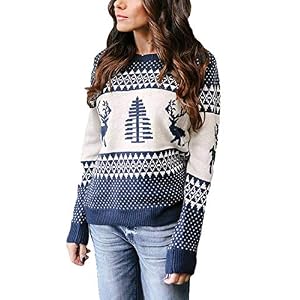 Office-safe
EXLURA Patterned Reindeer Knitted Christmas Jumper
£33.94 ($44.98) View on Amazon -
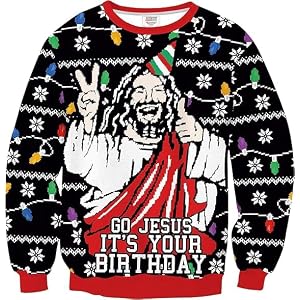 Office-safe
Budget 3D Graphic Christmas Sweatshirt, Unisex
£11.31 ($14.99) View on Amazon -
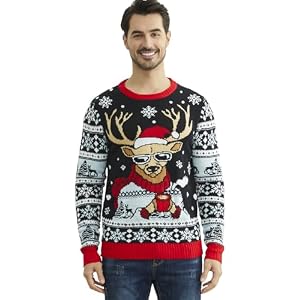 Office-safe
YIJIU Knitted Crew Neck Christmas Jumper for Men
£26.40 ($34.99) View on Amazon -
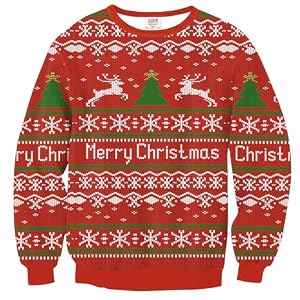 Office-safe
Arvilhill 3D Snowflake Print Christmas Sweatshirt
£15.08 ($19.99) View on Amazon