Nobody set out to invent the ugly Christmas jumper. It arrived by accident, was quietly laughed at for forty years, and then became one of the most reliable traditions in the British and American office calendar. This is the story of how a badly-knitted reindeer became a national institution — and where the modern versions came from.
The 1950s: the “Jingle Bell sweater” is born
The first festive knitwear sold as a novelty appeared in American department stores in the 1950s, marketed under names like the “Jingle Bell sweater”. Post-war Christmas was becoming a commercial event, and knitwear manufacturers realised that a snowflake motif could sell an otherwise ordinary jumper at a seasonal premium.
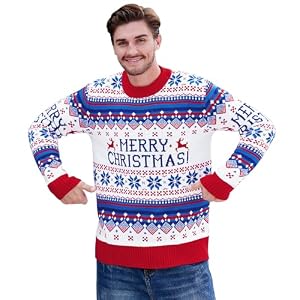
These early designs were not intended to be funny. They were sincere: neat rows of snowflakes, a tasteful reindeer border, maybe a bell or two. The design language of that era — repeating Nordic patterns, a yoke across the shoulders, chunky acrylic yarn — is still the template that modern “classic knit” jumpers copy. If you want that authentic mid-century silhouette, look at a traditional knitted pullover like the Santa, Reindeer and Snowflake knitted pullover or the Arvilhill knitted holiday pullover, both of which are direct descendants of that 1950s pattern book.
The 1960s and 70s: television makes it a costume
What turned festive knitwear into a recognisable character costume was television. In Britain, Val Doonican sat in an armchair in a different patterned cardigan every week and became so associated with the look that “Val Doonican jumper” entered the language as a gentle insult. In America, Andy Williams presented his Christmas specials in knitwear so aggressively seasonal that it defined the genre for a generation of viewers.
This is the point at which the jumper stopped being clothing and started being a signal. Wearing one said something about you — cosy, safe, a bit square, thoroughly committed to Christmas. That signalling function is the whole engine of the tradition, and it still is. The button-through cardigan version of the look survives almost unchanged in pieces like the Merry Xmas V-neck button cardigan.
The 1980s: peak sincerity, then the joke lands
The 1980s were the high-water mark for genuinely earnest Christmas knitwear. Shoulder pads, metallic thread, appliqué, tinsel woven into the yarn, three-dimensional pom-pom noses — the decade had no restraint and applied all of it to the Christmas jumper. Most of the garments now considered iconically “ugly” were designed in this period by people being completely serious.
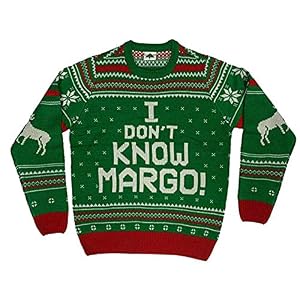
Then, in 1989, National Lampoon’s Christmas Vacation put Chevy Chase in one and the culture flipped. Clark Griswold’s knitwear was framed as comedy, and audiences understood immediately that the jumper had crossed over from sincere to absurd. The film’s grip on the tradition has never loosened, which is why Christmas Vacation designs remain among the most-worn jumpers at any office party — from the Griswold Family Christmas pullover to the Marty Moose eggnog glass design, and quote jumpers like “I Don’t Know, Margo” and “Why Is the Carpet All Wet, Todd?”.
2001: Bridget Jones and the British reindeer
Britain got its own defining moment in 2001, when Colin Firth’s Mark Darcy appeared at a family turkey curry buffet in a green jumper with an enormous reindeer head on the front. Bridget Jones’s Diary did for the UK what Christmas Vacation had done for the US: it fixed a single garment in the national memory as shorthand for well-meaning festive embarrassment.
It also cemented the British vocabulary. In the UK it is a Christmas jumper; in the US it is an ugly Christmas sweater. The garment is identical, and most manufacturers now label for both markets. The big-motif reindeer style Darcy made famous is still one of the most requested designs — see the Rudolph the Reindeer jumper.
2002: the first ugly Christmas sweater party
The tradition as we now practise it — deliberately seeking out the worst possible jumper and wearing it as a competitive sport — is usually traced to Vancouver, Canada, in 2002, where a group of friends held what they billed as the original Ugly Christmas Sweater Party. Guests raided charity shops for the most offensive knitwear they could find and prizes were awarded for the worst.
This was the crucial inversion. Before 2002, ugly jumpers were things you were given and grudgingly wore. After 2002, they were things you hunted deliberately. Once the goal became “worst wins”, the market had a clear brief, and manufacturers began designing jumpers to be bad on purpose.
2010s: the industry catches up
Two things happened in quick succession. In the UK, Save the Children launched Christmas Jumper Day in 2012, turning the garment into a fundraising ritual with a fixed date in December and giving every school and office in the country an official reason to take part. In the US, the third Friday of December became widely observed as National Ugly Christmas Sweater Day, and specialist brands moved in — Tipsy Elves being the best known, after its appearance on Shark Tank in 2013.
Charity shop supply could not keep up with a nationwide tradition, so the market filled the gap with jumpers manufactured to look thrifted. Brands like Tipsy Elves and Blizzard Bay built entire businesses on designing bad knitwear well.
The arms race: lights, 3D and printed illusions
Once everyone at the party is wearing a joke jumper, the joke has to escalate. Three innovations drove the last decade of the tradition.
Battery-powered lights
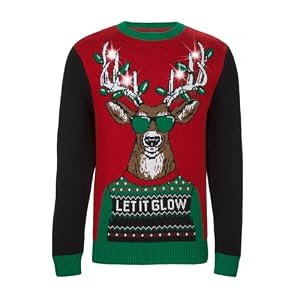
Cheap LEDs and coin-cell battery packs made genuinely illuminated jumpers affordable around 2013. A light-up jumper wins a room the moment the lights go down, which is why it remains the single most effective office party strategy. Current examples include the JOYIN LED light-up jumper with built-in bulbs, the motion-activated Ugly Sweater Co. LED jumper, and the Tipsy Elves light-up pullover. For a cheaper way in, there is the BLACKBARK LED jumper.
All-over sublimation printing
Knitting a complex image is slow and expensive. Printing one onto a polyester sweatshirt is neither. From about 2015, all-over 3D printing let designers put photographic detail, optical illusions and full-body scenes onto a garment for a fraction of the cost of knitting them — see the GTETKDE 3D-printed crewneck or the Mainfini 3D Xmas pullover.
Trompe-l’œil and the fake-garment gag
The most modern branch of the tradition is the jumper that pretends to be something else: a photo-realistic print of a body, a suit, or a second garment underneath. The jumper-over-a-shirt illusion print and the fake two-piece printed pullover are the current state of the art, along with the printed-muscles genre exemplified by the 3D muscle Santa hoodie and the chest-hair print jumper.
Where the tradition is now
Two forces are shaping the current decade. The first is licensing: film and franchise jumpers now account for a large share of the market, with Star Wars, Marvel, Home Alone, Elf and Die Hard designs all in steady demand. The second is sustainability. Environmental campaigners have criticised the volume of single-wear acrylic knitwear bought each December, and the response has been a visible shift towards jumpers people expect to wear for several years — better-made knits, plainer bases, and a renewed enthusiasm for second-hand.
Seventy years on from the Jingle Bell sweater, the garment has come almost full circle. It started as sincere seasonal knitwear, became a joke, became an industry, and is now — for a lot of people — a sincere seasonal jumper again, just with better gags on it.
Keep reading
- Christmas Jumper Day: dates, origins and how to take part
- How to choose an ugly Christmas jumper that actually wins the office party
- Nine office Christmas party jumper stories that get retold every year
- Film quote Christmas jumpers at the office party
- Christmas Jumper Day in six different workplaces
Two dates worth pinning down
Two moments in this story can be dated precisely. The deliberate ugly-jumper party was invented by Chris Boyd and Jordan Birch in Vancouver in 2002 — around thirty people at a house in Coquitlam, later filling the Commodore Ballroom. And the British tradition was fixed to a single Friday by Save the Children’s Christmas Jumper Day, first held on 14 December 2012, which has since raised more than £42 million.
Sources: CBC News and Save the Children UK. More on the day itself in our Christmas Jumper Day guide.