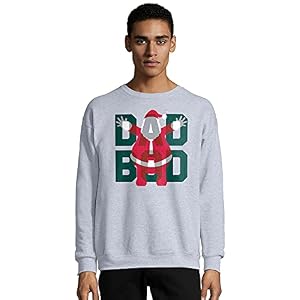
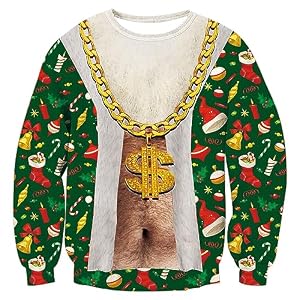
Most advice about Christmas jumpers assumes you are wearing one to a party. A large number of people are not. They are wearing one behind a bar, on a ward, in a classroom, on a shop floor or in a warehouse, for an entire shift, possibly for several weeks running.
That is a completely different garment requirement, and almost nothing written about the category acknowledges it. Here is what actually matters when the jumper has to last a shift rather than an evening.
Heat is the problem, not cold
People buy Christmas jumpers imagining a frosty walk. The reality for anyone working indoors in December is a building heated for customers in coats, while you are moving around in a jumper designed to be photographed.
An acrylic knit in a heated shop is genuinely unpleasant by the third hour. A fleece-lined sweatshirt is worse. What works is the opposite of what looks best in the product photograph: something light, breathable and preferably not lined at all. Some of the 3D-printed sweatshirts are made from moisture-wicking stretch fabric borrowed from sportswear, and for a full shift they are far and away the most comfortable thing in the category.
It has to survive a wash, repeatedly
A party jumper gets washed once, in January, or never. A work jumper worn through December gets washed every few days, and that changes which things survive.
- Sequins are out. They look superb under evening lighting and they do not survive repeated washing. Save them for a single night out.
- Light-up jumpers are difficult. The battery pack has to come out every time, and eventually somebody forgets.
- All-over prints wear at the shoulders first, which is exactly where a bag strap or a lanyard sits.
- Plain knit and brushed fleece are the two things that genuinely take repeated washing without looking tired.
The joke has to survive too
This is the part people underestimate. A slogan that gets a laugh once is a liability when four hundred customers read it over the course of a week. You will be asked about it constantly, and by the second day you will have stopped finding it funny.
Anything with innuendo is straightforwardly a bad idea in customer-facing work, for reasons covered in when the Christmas jumper goes too far. But even a good clean joke wears thin at volume. For a full season, a design rather than a slogan is the more sustainable choice — something that looks festive and does not demand a conversation.
Practical details that matter more than they should
- Pockets. Almost no Christmas jumper has them, and if you are on your feet with a phone, a pen and a set of keys, a hooded design with a front pouch is worth more than any amount of tinsel.
- Sleeves. Anything loose at the cuff is a problem around tills, taps, food and machinery. Ribbed cuffs stay put.
- Neckline. A high neck is lovely outdoors and unbearable over a long indoor shift. Crew necks are the safer bet.
- Colour. White photographs beautifully and shows everything. In hospitality that is a decision you will regret within an hour.
- Length. Reaching, lifting and bending all pull a short jumper up. A longer cut stays where you put it.
Buying for a team
If you are kitting out a shift rather than yourself, the arithmetic changes completely and so should the choice.
Order one first and check it before committing to a dozen — sizing on budget unisex ranges varies between colourways, and finding that out on delivery is expensive. Check the range goes far enough: a great many novelty jumpers stop at XL, and a tradition that only works if everyone joins in fails badly when it cannot fit everyone. And buy the boring one. Across fourteen people, the jumper nobody objects to beats the jumper three people love.
How differently this lands from one workplace to another is worth reading before you commit a whole team to it — see Christmas jumper day in six different workplaces.
The short version
For a single party, buy the loudest thing you can find. For a working shift, buy the lightest, plainest, most washable thing that still counts as taking part — and buy it a size up, because you will be moving in it for eight hours rather than standing still in it for two.
Almost every Christmas jumper is made of plastic
The environmental charity Hubbub examined 108 Christmas jumpers on sale across 11 UK retailers in 2019 and found that 95% were made wholly or partly from plastic. Three quarters contained acrylic, and some were entirely acrylic. Only 29% of shoppers surveyed realised this. Separately, research at the University of Plymouth found acrylic sheds close to 730,000 microfibres in a single wash — more than polyester or a polyester-cotton blend. None of this makes acrylic the wrong choice; it makes buying one jumper that lasts a decade a materially better decision than buying a cheap one every year.
Source: CNN, reporting Hubbub research